

What's New in DirectX 12? Understanding DirectML, DirectX Raytracing and DirectStorage
DirectX has been with u.s. for 25 years, providing developers with the tools to brand incredible games. The latest version, DX12 was released in 2022 but in the by couple of years, Microsoft have been expanding the software library to embrace ray tracing and machine learning, and eventually, data management.
Large next-gen titles like Cyberpunk 2077, Far Cry six and Spotter Dogs: Legion are using some of these DirectX 12 extras. So what exactly are they? What tin these enhancements practice and how volition they brand games better for united states of america all?
All skilful questions and we've got you lot covered: read on to notice out!
What exactly is DirectX 12?
Let's start with a quick caption of what is DirectX. Take any mod game, be it one of the latest blockbusters or a tiny indie offering, and you'll observe that it's been coded in a general purpose language, such equally C++. All of the graphics, sound, gameplay mechanics are in the thousands or one thousand thousand of lines of instructions -- take this data, multiply information technology with that data, put the upshot here, and and so on.
Only much of this work will exist common, no matter what the game is or what platform it gets played on. So to make the process of making a game easier, Microsoft created a set of low-level APIs back in 1995. Think of these as an enormous drove of books, in which all kinds of rules and structures are fix out almost how well-nigh to issue instructions and what information types to use, also as offering simplified commands that can exist used in place of long sequences of code.

DirectX provides APIs for graphics, sound, video, music, and input devices -- pretty much everything you're going to need to play a game on a PC. The drivers for the devices that generate or use these multimedia functions will translate the instructions from the API, turning them into sequences of code that the hardware understands.
Microsoft has continually updated this massive library over the past 25 years, and the latest version called DirectX 12, was released to the public in late July 2022, with the launch of Windows 10. Just equally mentioned before, it's kept receiving additions...
DirectX Raytracing
The showtime improver to the DirectX 12 collective was a software structure for ray tracing, The 'holy grail' of graphics and something that'south been a near constant source of wonder and criticism, in equal measure.
DXR a.k.a. DirectX Raytracing first appeared in belatedly 2022 and has been created in conjunction with Nvidia, AMD, and Intel.
Nvidia was the first to offer hardware support for it, with their Volta-based GPUs, even though these chips didn't have whatsoever specific features to handle ray tracing. That changed with the launch of Turing-powered GeForce RTX graphics cards in September 2022, and Nvidia's marketing team heavily promoted RTX as being the next pace in the evolution of graphics.
AMD followed adapt in November 2022 with the launch of their RDNA 2 architecture, equally used in Radeon RX 6000 graphics cards, the Xbox Series Ten/Southward and PlayStation five consoles.

We've covered the difference between ray tracing and traditional rasterization before, so nosotros'll focus specifically on what DXR is doing.
For decades, 3D games accept been using a variety of techniques to simulate how the color and effulgence of an object will appear, based on the impact of lite sources and shadows. But it's always been somewhat of a flim-flam -- an estimation of how light actually interacts with surfaces. Ray tracing works by following the path of a light ray, and seeing what objects it interacts with. Then, based on the information about that surface, the colour and intensity of the low-cal is calculated.

The ray might be reflected, absorbed, or refracted (i.eastward. passes through, only at an bending), and and so the process can continue to follow the ray, as it ricochets effectually the scene. With today's hardware, doing this for one ray isn't super difficult, simply for it to produce realistic results, each pixel in the frame needs at to the lowest degree one ray to be cast out and traced.
And if the frame has a resolution of 1920 x 1080 pixels, that would result in a little over 2 million rays. That's no small amount of work to handle, so annihilation that can be done to aid out becomes compulsory, rather than optional.

There are various techniques, chosen dispatch structures, that can be employed to aid speed upwardly the process of post-obit the rays through the scene. DXR sets out the overall rules behind these structures, splitting them into two types: lesser level and meridian level. Bottom level acceleration structures (BLAS, for short) incorporate information nearly the primitives -- the shapes that are used to build up the surround.
Setting up each BLAS takes time, but they provide a quick system for checking whether or not a ray interacts with a shape. However, recreating all the different BLAS for every new frame is very time consuming, and this is where the top level ones (TLAS) come into play.

Rather than containing all of the data near the geometry of the shapes, TLAS contain pointers (references to 1 or more specific BLAS) or instances (several references to the aforementioned BLAS). TLAS as well incorporate data about how the primitives in the BLAS may have be transformed (east.k. moved, rotated, scaled) and other aspects, such equally the archaic's material properties (east.g. transparency).
This makes TLAS much quicker to setup than BLAS, just excessive use of them affects functioning. DXR doesn't state what methodology should be used to create the acceleration structures -- information technology leaves that to the hardware/driver to interpret the API's instruction to make them.

AMD and Nvidia use bounding book hierarchies (BVH) and these are managed entirely by the GPU. Why? Because their processors comprise specialized circuits for whipping through such structures (chosen BVH traversal), speeding up the process for determining if a ray gets anywhere nigh a given primitive.
The idea behind them is that the volumes are organized with respect to how the primitives are set from the perspective of the photographic camera, then that the start book to intersected past a ray is the one that gets analyzed farther; the others are automatically rejected. The testing algorithm and then checks through successive layers of volumes until the last level is reached.
The DXR pipeline requires the BLAS/TLAS to exist created first, and and then for each pixel in a frame, run a shader to generate a ray. This shader then uses the acceleration structure to determine whether or not information technology direct hits a surface, and ray tracing GPUs also have additional units to speed this up too.

The outcome of the ray-primitive intersection check depends on what instructions accept been coded to take place. One or more of the following shaders can be made to run:
- Hitting shader
- Any-hit shader
- Closest-hit shader
- Miss shader
The start and concluding ones are obvious: if the ray hits or misses a primitive, then the shader volition render a specific color, or fifty-fifty activate another ray. Whatever-hit shaders can exist activated if the ray blasts through multiple things, useful for treatment translucent surfaces such equally h2o or glass. Closest-hit does what the name suggests and activates the routine based on which primitive is closest to the ray, and tin be used for determining the colour of a shadow, for case.
This cycle of generating a ray, checking for an intersection, and figuring out of the color can be looped every bit many times equally required, to attain ever more realistic results. All of this scaled over millions of rays would grind a game's operation into the dirt withal.

So virtually implementations of DXR involve a hybrid approach: utilize the normal Direct3D graphics and compute pipelines to create the scene, apply textures, general lighting and post-processing furnishings, and switch to the DXR pipeline for very specific things, such as reflections or shadows.
Another common technique that's used to proceed the functioning striking every bit low as possible, is to limit the number of rays cast into the scene -- typically done by using one ray per cake of pixels, rather than one ray per pixel -- or simply using a primary ray, and non tracing the bounces.
The downside to these approaches is that the end result contains lots of artifacts or noise.

At that place are lots of possible solutions to countering this, collectively known as denoising. With graphics cards, this is typically done with shaders to sample so filter the completed frame (we'll say more on this in a moment).
Now that the latest consoles and graphics cards sport ray tracing features, Microsoft is clearly going to go on developing and expanding DXR, to give more control and flexibility as to how rays are generated from shaders and how to manage them. The API'south first update appeared in May 2022, adding a grouping features under the title of DXR Tier one.1. Unlike nearly DirectX updates, these additions don't require new hardware, only updated drivers.
DirectML
The adjacent enhancement, DirectML, became bachelor in the Windows 10 May 2022 update. This one is all almost Machine Learning, a loose term used to describe a whole range of programming paradigms and algorithms.
In the case of Microsoft's API, information technology provides a uniform construction with which to accelerate the processing of inference models on a GPU. Similar DXR, it doesn't specify exactly how the hardware should practise it -- you simply write your code and allow the drivers handle it for you.

Machine learning used to exist the preserve of powerful multi-CPU computers, but equally GPUs have become more capable, they've taken over this curl. When Nvidia released Volta in mid 2022, they introduced a new hardware characteristic in their fries: Tensor Cores.
These units exclusively handle so-chosen tensor operations, a branch of mathematics that involves handling large sets of related numbers at the same time. Tensors are heavily used in neural network operations, ane of the key elements in inference models.
A GPU doesn't need to have tensor cores in society to support DirectML -- in fact, you don't even demand a GPU. This is all thanks to a Direct3D 12 characteristic chosen meta commands. These are lawmaking objects that allow hardware vendors to use specific features in their devices to perform the calculations.

And so even though DirectML is said to exist hardware-agnostic (i.east. it'south oblivious to the nature of the hardware handling the instructions), meta commands provide a means for a GPU to use its own unique way of doing things.
In the case of Nvidia and their Volta/Turing/Ampere GPUs, if the meta commands are prepare in the right manner, then the Tensor Cores will kick in and process the math; if not, then the GPU falls back to running the shaders on the 'standard' cores. And if they're not available, and then the CPU handles the operations instead.
This is all very nice, but what exactly tin developers do with DirectML?
There are three detail applications of note:
- Anti aliasing
- Upscaling and then-called 'super resolution'
- Denoising
None of these require DirectML, but the combination of the API'due south features and use of meta commands means that Intel, AMD, and Nvidia can all provide some kind of hardware acceleration for these techniques. In the case of the latter, they've already been using their Tensor Cores for a proprietary algorithm called Deep Learning Super Sampling (DLSS).

DLSS allows a game to run at a lower resolution, and reap all the performance benefits that brings, merely present the final rendered frame at a much higher resolution. This might sound like a simple upscaling process, as used past Blu-ray players when they convert a DVD movie to a HD output.
Simply neural networks tin can provide results with better quality because it can arrange the color of pixels to correctly account for motion, based on where objects were and where they're moving to. The likes of DLSS tin produce astonishing results and DirectML can be used to produce like algorithms. This technique has picked up the proper noun Super Resolution and it will exist especially useful in games that are heavily using DXR
By reducing the frame resolution, fewer rays are required to shade the scene and thus the performance hit from using ray tracing becomes more adequate. Then scaling the paradigm support for the monitor means yous don't accept to expect at a pixelated mess.

DirectML tin likewise exist used to utilize loftier quality denoising, so even fewer rays tin be bandage about, without affecting the image quality likewise much. In the higher up image, you can come across a ray traced image on the left, where simply one primary ray per pixel has been used, and then the same process once again, merely with Intel's neural network Open Paradigm Denoiser applied, on the right.
Since its release, the auto learning API has received ii updates, bringing a wealth of additional operations and extra information type support. Unlike DXR, no games at the moment appear to exist using DirectML for anything, merely it won't be long before they practise.
DirectStorage
The third enhancement we're going to embrace hasn't been released even so, and information technology's still yet to striking the developer preview phase. That means details are still scarce besides what Microsoft has told usa via their programmer weblog. DirectX DirectStorage is another API, but one that's not dedicated to graphics.
This software library was originally created for Xbox Series 10 / S consoles and is existence brought across to Windows 10 computers to offer similar advantages. DirectStorage volition allow games and other programs more than direct admission to resources on a primary storage bulldoze, than how things are currently done.
When you play a PC game today, all the textures and models needed to create the graphics are offset copied from the local storage and written into the system memory. Then, this is all copied again and written into the graphics bill of fare'southward memory.

This, in itself, isn't that much of a trouble, as the transfer from the local storage to RAM is ordinarily the slowest part of the whole sequence. However, a modern AAA title might have an enormous amount of resources on the bulldoze, and then rather than trying to copy everything it needs, or might need, the game but requests small chunks of information technology.
This is especially truthful in open world games, where new textures and models are requested on a regular basis. Every time this happens, the CPU has to process what are called I/O requests (input/output), and so if there are lots of requests constantly taking place, the CPU is going to be kept rather busy dealing with them all. This, in turn, limits the corporeality of system compute resources available for everything else -- for the game, this might be treatment AI, path-finding, netcode, input monitoring, etc., only information technology also has an bear upon on the game'south resources, likewise.

Many titles these days store textures, sound, and model files in a compressed format (especially if it's digitally delivered). Earlier such resources can be used, they need to exist decompressed by the CPU and if that's already decorated handling lots of I/O requests, so transferring data from storage to the graphics carte du jour only gets bogged downwards.
We feel such things in the form of long load times, or stuttering during gameplay, and anything that can be done to better such matters tin can only be a skilful thing.
The key tricks DirectStorage employs to help out are bundling I/O requests into batches, rather than handling them in a serial manner, and letting games make up one's mind when they need to exist told that a request has been completed. The CPU withal has to work through of all this, of course, but information technology can now use multiple threads in parallel to the task.
Another reason why this change is needed, is the adoption of faster NVMe SSDs for local storage. These are blindingly fast, sporting huge amounts of data bandwidth, compared to SATA drives. The latter take quite a comparatively long time to complete an I/O request, whereas the former can blast through them.

DirectStorage probably won't provide any heave for older PCs and games, merely for the latest machines and titles to come, the employ of this API will assistance to give usa quicker loading times, faster data streaming, and a bit more CPU breathing space. All thanks to a new software library!
Unfortunately, developers won't be able to get their hands on DirectStorage for beta testing until next yr, and in that location's no indication every bit to when it volition be publicly released.

Meanwhile, you lot may take heard that Nvidia is developing something they're calling RTX IO. This system is non the aforementioned DirectStorage under a proprietary name, every bit information technology'southward almost having a means to bypass copying resource to the system memory. Instead, a game could straight transfer data from the storage drive to the graphics card's local retention.
Still, information technology is beingness designed to be used in conjunction with Microsoft's forthcoming API, to further reduce the corporeality of I/O requests the CPU manages. And where one vendor has started something, others soon follow.
When 12 became Ultimate
Before we close off this look at DirectX 12's side by side-gen enhancements, it'due south worth commenting on an update to DirectX that Microsoft released in March 2022.
In previous DX iterations, small-scale releases followed the convention of version numbering. For example, DirectX 11 came out in the Fall of 2009, eleven.1 in 2022, and xi.2 a year subsequently. However, DirectX 12 remained as '12' for nearly 5 years, until they announced DirectX 12 Ultimate.
This revision brought significant updates to Direct3D and DirectX Raytracing (which we've now covered), so permit's take a quick expect at the former's new features:
- Variable Rate Shading (VRS)
- Mesh Shaders
- Sampler Feedback
The first ane substantially allows developers to command how ofttimes shaders get applied to a whole scene, role of it, or even just an individual primitive. Normally, shaders are applied to each pixel in a frame, just Variable Rate Shading allows you to select a block of pixels (e.thousand. two x 2) and run the shaders on that.

Although this results in a subtract in visual quality, the functioning do good is potentially huge, so if you don't demand something to look super accurate because it's in the distance or moving by really quickly, decreasing the shader rate is a sensible thing to do.
Mesh shaders are a logical enhancement to geometry and vertex shaders, the tools used to move and scale the objects and environment in a scene.

Traditionally, this area of vertex processing has been quite rigid in terms of programming flexibility and command, but mesh shaders pushes information technology towards the realm of compute shaders.
The benefit for united states of america will exist in the form of having more complex models and scenery in our games, without suffering lower performance. This is something that we've heard before, over the years, particularly with tessellation and geometry shaders, but this time round it's a 18-carat comeback.
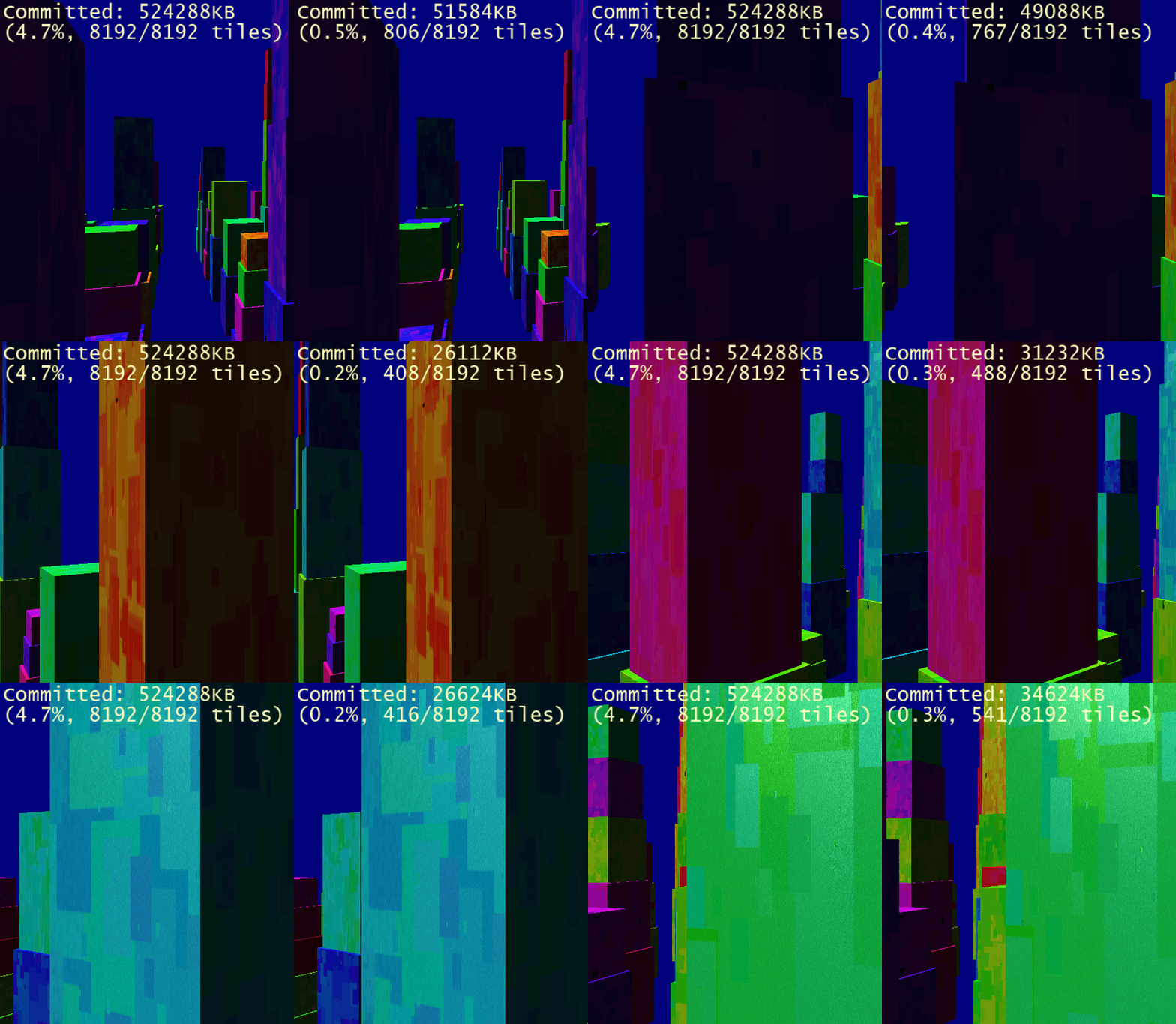
Sampler Feedback operates on a similar theme: giving the developer more than data and control, but about what textures they're using. The advantages this can potentially bring is reducing the amount of textures that need to be streamed from memory into the GPU, and for where a game has rendered objects as textures, it permits them to exist used more than effectively and thus more quickly.
The terminal feature of DirectX 12 Ultimate isn't a absurd new graphics play tricks or an API to speed upwardly data treatment. Microsoft accept unified their APIs for Windows and the Xbox platform into one cohesive library -- in theory, this should brand it far easier to create a new title that will require minimal work to port information technology from ane organisation to the other.
This was the idea behind the original Xbox, but the 360 veered away from this (every bit did the One, but to a lesser extent), by using a hardware and software design that wasn't overly PC-like. With the Series X and S, the internals are about as close to being a PC, without actually being i, so information technology made sense for the software to follow accommodate.
What's good for developers is adept for us
Although everything we've covered here is actually for developers to utilize and take reward of, we're the ones who ultimately benefit, even though it will take some time before all such features are commonplace in games.
While the focus is nevertheless about creating ever more realistic graphics, especially as far every bit ray tracing is concerned, Microsoft accept kept a keen eye on performance. This is because it's condign increasingly more than difficult for hardware vendors to create new products that are significantly more powerful that their predecessors, for a price tag that appeals to the majority of consumers.
Non everyone can afford nor wants to spend a $i,000 on a graphics card, only to run games at their highest settings and still get good frame rates. And publishers typically want their titles to accomplish as many consumers as possible, rather than just being for a select few.
All of which means that DirectX 12 Ultimate, and all its nifty enhancements, are going to exist used to make better looking games, that all of united states can enjoy.
Continue Reading. Hardware at TechSpot
- Display Tech Compared: TN vs. VA vs. IPS
- five Signs Your Storage Drive Is Almost to Fail
- The Best Graphics Cards
- Gone but Not Forgotten: 3Dfx Interactive
Shopping Shortcuts:
- Nvidia GeForce RTX 3080 on Amazon
- Nvidia GeForce RTX 3070 on Amazon
- AMD Radeon RX 6800 XT on Amazon
- AMD Radeon RX 6800 on Amazon
- Sabrent Rocket PCIe iv.0 SSD on Amazon
- Corsair MP600 PCIe 4.0 SSD on Amazon

Source: https://www.techspot.com/article/2137-next-gen-directx-12/
Posted by: richmonddombef.blogspot.com
0 Response to "What's New in DirectX 12? Understanding DirectML, DirectX Raytracing and DirectStorage"
Post a Comment